Volleyball Code Features
Volleyball Code turns spoken play-by-play into live scoring, rotations, and championship-grade analytics — no laptop courtside, no paper scoresheet, no second device. Here is every feature, what it does, and why it matters on the bench.
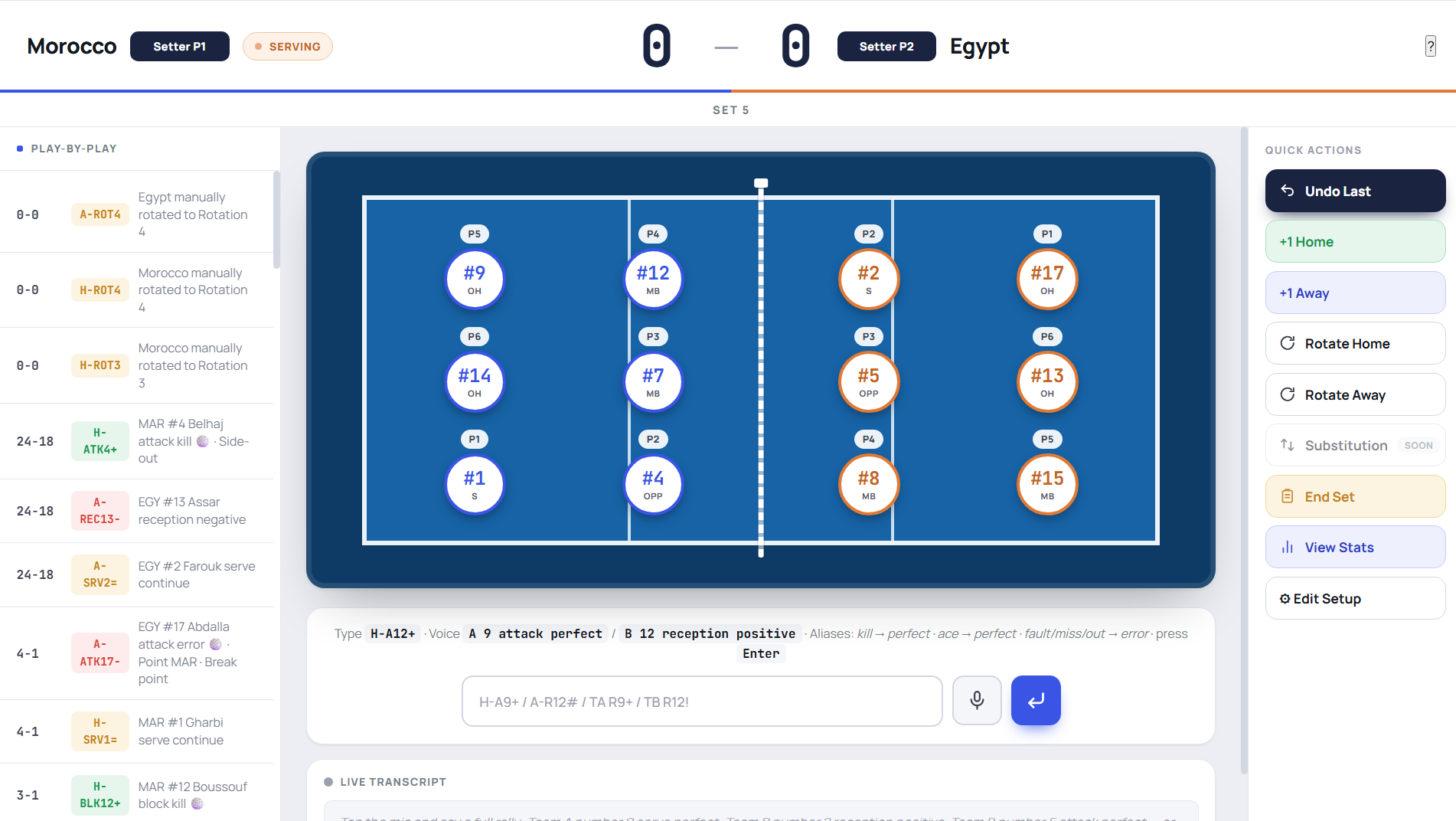
Every feature below points at one goal: let you code a full match while your eyes stay on the court. Two of them — voice coding and analytics — are deep enough to have their own pages, linked at the end of each section.
Voice-native coding
Speak a full rally and the app parses the team, jersey number, skill, and result, then shows it back for a one-tap confirm before anything scores. Say "Team A number 9 serve ace, Team B number 2 reception error" and both actions are logged and the point awarded before the next serve. Prefer typing? Keyboard shorthand like H-A9+ works too.
Live court & rotations
A real court keeps both line-ups in view with P1–P6 positions. Rotate either team with one tap, track the active setter and libero, and get a warning the moment the libero lands in the front row. Side-outs rotate the receiving team automatically, so the court on screen always matches the court in front of you.
Read the rotations guide →Advanced analytics
Side-out %, attack efficiency, reception quality, and break-point % recompute the instant you confirm a rally — filterable by team, player, rotation, and skill. These are the same numbers national-team analysts watch, produced live from the rallies you speak.
See the analytics, explained →Player & rotation breakdown
Per-player tables and a P1–P6 rotation matrix show exactly where points are won and lost. When one rotation leaks side-outs or one hitter is carrying the attack, it is obvious at a glance — which makes substitutions and serving targets easy to call.
How to track volleyball stats →CSV & PDF reports
Export the full match to CSV to feed your own models, or generate a clean PDF report — team stats, player breakdown, and P1–P6 rotation analysis — to hand players and staff minutes after the final whistle. No copying numbers off a whiteboard.
FIVB rules by default
Best of 5, 25 points per set, a 15-point tie-break, and 5-1 / 6-2 systems are preset. Set your teams up once and start coding — there is no configuration to redo every match.
How the features fit together
In practice they form one loop. You speak the rally (voice coding), glance and confirm, and that single confirmation updates the live court and rotation, recomputes every analytics card, and adds to the player and rotation breakdown — all of which the CSV and PDF report then packages up at the end. One spoken sentence per rally drives the entire app.
Frequently asked questions
Do I need any extra equipment to use Volleyball Code?
No. It runs in your browser on any phone, tablet, or laptop with a microphone. There is nothing to install, no scoresheet, and no second device — you code the match by voice and read the analytics on the same screen.
Can one coach run the whole match alone?
Yes. Because coding is voice-native, you never look down to tap a stat, so a solo coach can track a full match while still watching and coaching the game. That is the core reason the app exists.
Which volleyball rules does the app follow?
FIVB indoor rules by default: best of 5 sets, 25 points per set, a 15-point tie-break, and 5-1 or 6-2 systems. You set your team up once and start coding — there is no per-match configuration.
Is my match data saved if I lose connection?
Yes. Every confirmed rally is written to your device first and synced to the cloud when you are online, so a dropped signal courtside never loses your match.
Try every feature on your next match
Set your roster, hit record, and call the rally. Volleyball Code handles scoring, rotations, analytics, and the report while you keep coaching. Start free, no card.
Start free →Go deeper: Voice coding, explained · Volleyball analytics, explained · Volleyball Code for coaches · FAQ