Voice Coding, Explained
Voice coding is the heart of Volleyball Code: instead of tapping a tablet or filling a scoresheet, you say what happened after each rally and the app writes it down — scoring the point, rotating the court, and updating every stat while your eyes stay on the game. Here is how it works, and why it stays accurate.
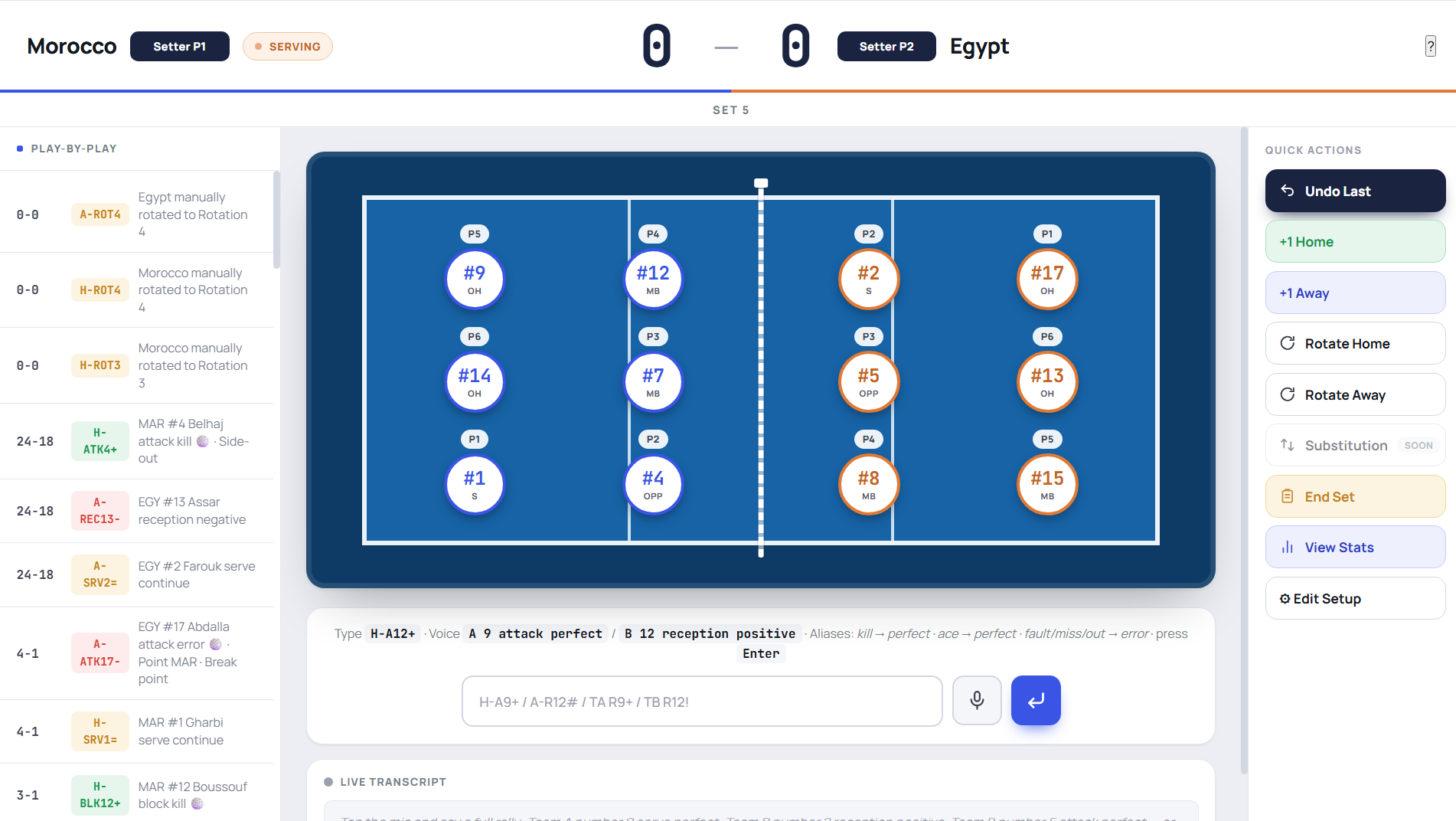
The command pattern
Every rally you call follows one simple, spoken pattern:
team [A / B] · number [jersey] · [skill] · [result]Spoken naturally, in one breath, a real rally sounds like this:
The app hears both actions, scores the point for Team A, and logs the serve and the reception against the right players — all before the next serve.
You do not need robotic pauses or perfect diction. Say the team first so touches are attributed correctly when both sides play the ball, then the number, the skill, and how the touch ended.
The skills and results you can call
There are seven skills and five results. The skill is the touch; the result is how it ended.
| Skills | Results |
|---|---|
| Serve, reception, attack, block, dig, set, free ball | Point/perfect (#), positive (+), continue (!), poor (-), error (=) |
Only the result that ends the rally moves the score. An ace, kill, or stuff block scores for that team; an error or fault gives the point to the other side; "positive", "continue" and "poor" mean the ball stayed in play and the rally continues. When a point is scored on serve-receive, the winning team rotates automatically.
What happens after you speak
Between your voice and the scoreboard sits a short pipeline built to absorb the messiness of a live gym:
- Transcribe. Your microphone streams to a live speech engine that turns your words into text in real time.
- AI-correct. The raw transcript is cleaned up by an AI pass that fixes stumbles and normalises wording, so "number nine" and "nine" both land.
- Parse. The corrected text is split into structured actions — team, number, skill, result — one per touch you called.
- Confirm. Those actions appear as a short list for you to glance at. Nothing is committed until you approve it.
That final confirm step is the safety net. It is why voice coding stays accurate even when the gym is loud: if a number or skill came out wrong, you fix it in one tap before it ever touches the score.
Prefer typing? Keyboard shorthand works too
Voice is the fast path, but it is not the only one. You can type compact shorthand for the same action — for example H-A9+ codes home team, attack, number 9, positive result. Voice and keyboard mix freely in the same match, so you can speak most rallies and type the odd one when you want to.
Why code by voice at all?
The honest reason is attention. Every second spent looking down at a device to tap a stat is a second you are not watching the match. Voice removes the screen from the loop: you watch the rally, describe it, and keep coaching. For a solo coach with no statistician on the bench, it is the difference between tracking a full match and tracking nothing at all — and once the pattern is muscle memory, usually within a set, you stop thinking about the mechanics entirely.
Tips for clean voice coding
- Say the team first, every time. It keeps actions attributed correctly when both sides touch the ball in one rally.
- Only the last touch scores. You can narrate a whole rally, but the result that ends it — ace, kill, error — is what moves the scoreboard.
- Trust the glance-and-confirm. Re-checking every rally by hand costs more time than the rare correction saves.
- Pick your wording before the whistle. Being consistent about "positive" versus "perfect" keeps your stats comparable across matches.
Frequently asked questions
Do I have to speak in a robotic way for it to work?
No. Speak naturally in the team-number-skill-result pattern. The transcript is AI-corrected before it is parsed, so filler words, small stumbles, and "number nine" versus "nine" all resolve correctly.
Does voice coding work in a loud gym?
Yes. Two things keep it accurate under noise: the transcript is AI-corrected before it becomes actions, and nothing is committed until you confirm the short action list, so any mishearing is caught before it affects the score.
What if I prefer typing?
You can type keyboard shorthand instead of speaking. A command like H-A9+ codes the same action, so voice and keyboard can be mixed freely in the same match.
Which skills can I call?
The seven core skills — serve, reception, attack, block, dig, set, and free ball — each followed by a result: point/perfect, positive, continue, poor, or error.
Code your next rally by voice
Set your roster, hit record, and call the play. Volleyball Code handles the scoring, rotations, and stats while you keep coaching. Start free, no card.
Start free →Related: How to record a match by voice · The analytics it produces · All features · FAQ